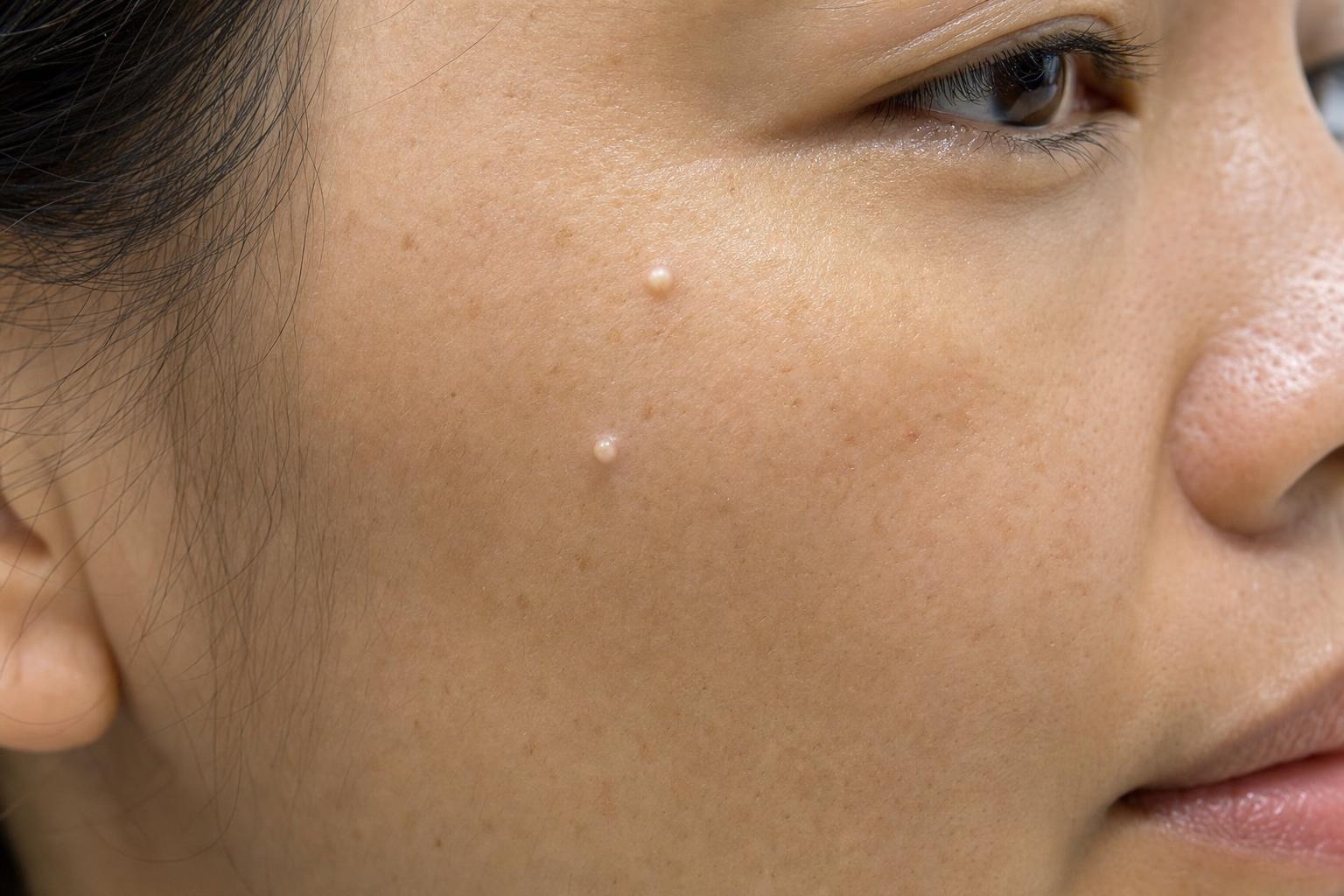
Tiny white bumps can look nearly identical in the mirror, but two common causes behave differently. Milia are firm, keratin-filled cysts that sit beneath the skin’s surface. Whiteheads are closed pores containing oil, dead skin cells and other debris. Milia often remain unchanged for weeks or months; whiteheads are more likely to appear alongside other signs of acne and may eventually become inflamed.
That distinction matters because acne products do not instantly empty a milium, while squeezing either type of bump can injure the skin. Texture, location, surrounding redness and changes over time offer useful clues, but a photograph or home inspection cannot confirm every lesion. If a bump is unusual, changing or close to the eye, professional assessment is the safer next step.
Key takeaways
- Milia usually feel like firm, pearly beads under an otherwise calm skin surface.
- Whiteheads are closed comedones caused by clogged pores and may occur with blackheads, pimples or oily skin.
- Milia are common around the eyelids and upper cheeks; acne can occur anywhere there are oil-producing follicles.
- Squeezing, piercing or cutting a bump at home can cause bleeding, infection, pigmentation changes or scarring.
- Seek professional advice when the identification is uncertain, the area is inflamed or the lesion changes.
What each bump actually is
A milium is a very small cyst containing keratin, a structural protein found in skin, hair and nails. It typically appears as a white, cream or pale-yellow bump just below the surface. Although people sometimes describe milia as trapped oil, they are not ordinary pimples and do not have the same pore blockage as acne.
Primary milia can develop spontaneously, including on healthy skin. Secondary milia can occur after skin damage or inflammation. Babies frequently develop facial milia, but adults can have them too. The DermNet overview of milia notes that these cysts commonly affect the eyelids, cheeks, nose and upper trunk.
A whitehead is a closed comedone, one of the non-inflammatory forms of acne. It develops when the opening of a hair follicle becomes blocked by sebum and dead skin cells. Because the material remains covered by a thin layer of skin, the bump looks white or flesh-coloured rather than dark. A blackhead is related, but its pore is open; exposure to air causes the material at its surface to oxidize and darken.
Whiteheads may remain small, or inflammation within the follicle may lead to a red, tender pimple. They often occur with other comedones rather than as one isolated, hard pearl. DermNet’s clinical explanation of acne provides more detail about comedones and inflammatory acne lesions.
How to tell them apart
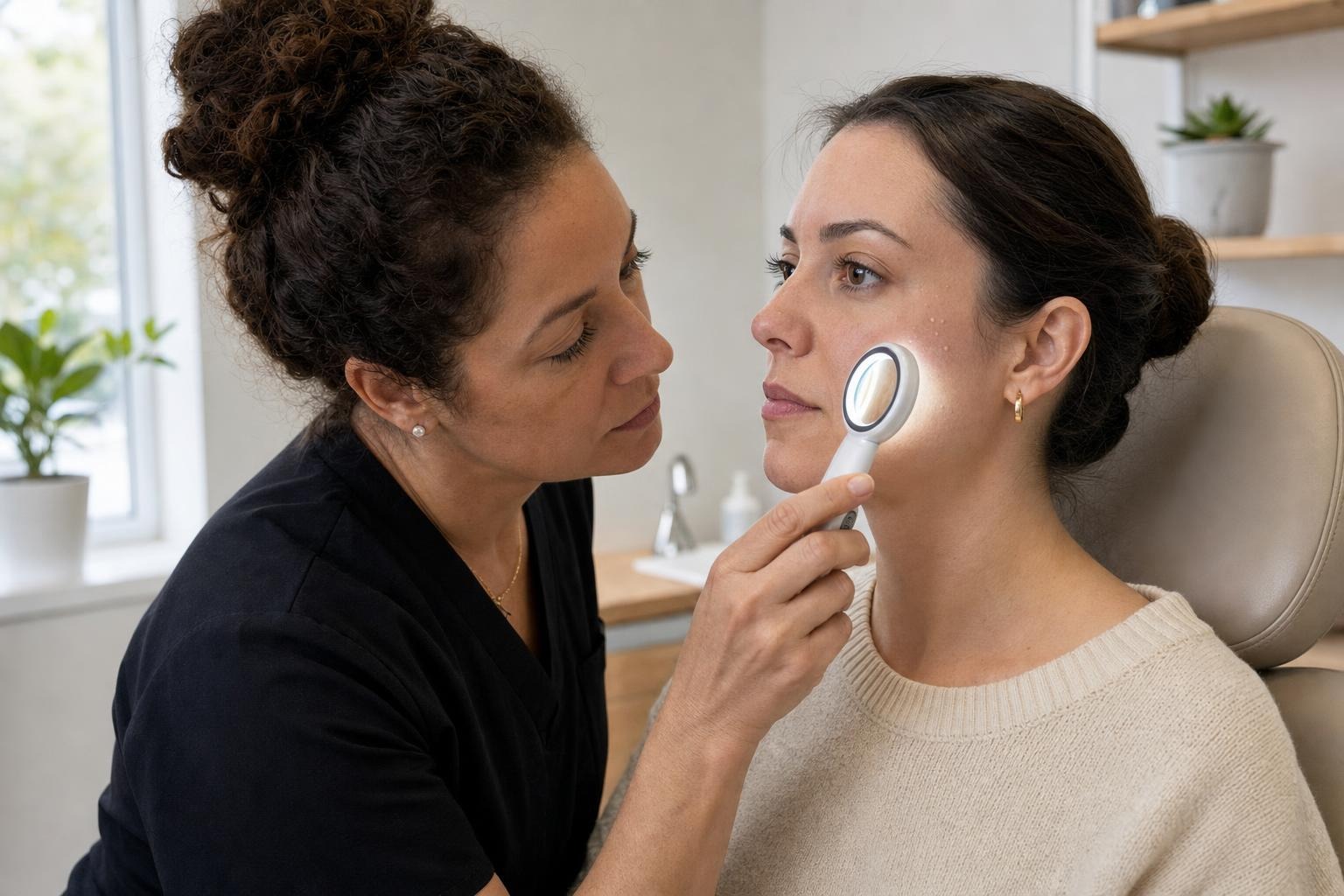
Start with four practical clues: firmness, surrounding skin, visible pore structure and behaviour over time. No single clue is definitive, but the combination can point in one direction.
Texture and depth
Milia tend to feel hard for their size, much like a tiny seed beneath the skin. They may look superficial but resist gentle pressure because their contents are enclosed within a small cyst. A whitehead is often softer or less sharply defined, although touching alone is not a reliable diagnostic test.
Avoid repeatedly pressing the area to compare textures. That mechanical irritation can turn a minor clogged pore into an inflamed lesion and can redden the skin around a milium.
Colour and surrounding inflammation
A typical milium is uniformly pearly white, cream or yellowish. The surrounding skin generally looks normal unless the area has been picked or rubbed. Whiteheads may be white or skin-coloured and can sit within a mildly raised patch. If acne inflammation develops, redness, swelling or tenderness may appear.
Milia can also become irritated, so redness does not automatically make a bump acne. Recent squeezing, a scratch or friction from eyewear can alter its appearance.
Visible opening
Neither lesion necessarily has an obvious opening. A closed comedone is, by definition, covered at the surface. A milium is enclosed as well. This is why searching for a pore with a magnifying mirror rarely settles the question and may encourage unsafe attempts at extraction.
Changes over time
A milium often looks virtually the same from week to week. Some resolve without intervention, while others persist. Whiteheads can come and go more quickly, especially when they are part of an acne pattern. They may flatten, develop into an inflamed pimple or be replaced by new comedones nearby.
Why location and pattern matter
Location is a clue, not a diagnosis. Milia commonly cluster around the lower eyelids, upper cheeks and nose. Adult facial milia may appear as a few separate, evenly shaped bumps in areas that are not otherwise acne-prone.
Whiteheads are common on the forehead, nose, chin and cheeks, but they can also affect the chest, shoulders and back. Look at the wider pattern: nearby blackheads, red pimples and recurring clogged pores support acne as a possible explanation. A single firm bump near the eye, with no other signs of acne, may be more consistent with a milium.
Products can influence the pattern. Heavy or occlusive cosmetics may contribute to breakouts in some people, while irritation from skin treatments can make any bump more noticeable. Instead of abruptly adding several active ingredients, review what changed before the bumps appeared—such as a new sunscreen, rich eye product, hair product or exfoliant.
Not every white or pale facial bump belongs to either category. Sebaceous hyperplasia, small cysts and other skin lesions can resemble them. Around the eyelids, particular care is warranted because the skin is thin and the eye itself is vulnerable.
What not to do at home
Do not pierce a bump with a sewing needle, pin, lancet or other household tool. Even when a video makes extraction look straightforward, it does not show whether the lesion was correctly identified, whether the equipment was sterile or how complications were managed.
Forceful squeezing is also a poor test. The material inside a milium is held within a cyst and may not exit through pressure alone. Trying harder can tear surrounding tissue without removing it. Squeezing a whitehead can push inflammation deeper, increase redness and contribute to post-inflammatory dark marks or scarring.
Avoid aggressive scrubbing and stacking multiple strong products. For example, combining a physical scrub, an acid exfoliant and a retinoid can damage the skin barrier. Burning and peeling are signs of irritation, not proof that a bump is being removed.
The eye area deserves stricter limits. Do not apply acne medication close to the lash line unless its directions specifically permit that use and a qualified professional has advised it. Never attempt to cut or extract a lesion on an eyelid at home.
Treatment options for each type
The appropriate approach depends on what the bump is, where it sits and whether it is causing a problem.
Managing milia
Some milia disappear naturally, making observation reasonable when a bump is small, stable and not bothersome. Gentle cleansing and daily sun protection support general skin health, but there is no need to scrub the area.
A clinician may recommend a topical treatment in selected cases or remove a persistent milium using an appropriate professional technique. Location matters: treatment near the eye requires particular precision. Vicaria Health provides information about professional milia and skin lesion removal in Hamilton, including consultations without a referral. A consultation should establish whether the spot is appropriate for the offered service before removal is considered.
Managing whiteheads
Because whiteheads are acne lesions, treatment usually focuses on preventing follicles from becoming blocked. Depending on skin sensitivity and individual circumstances, commonly used non-prescription ingredients include salicylic acid and topical retinoids. Benzoyl peroxide is often used for inflammatory acne, although it may be less directly useful for a small isolated closed comedone than a pore-clearing treatment.
Introduce only one active product at a time and follow its label. More frequent application does not necessarily produce faster results; it often produces irritation. Retinoids require particular caution during pregnancy or when trying to become pregnant, so advice from a physician or pharmacist is appropriate.
If whiteheads are widespread, recurring or accompanied by painful inflammatory acne, a primary-care clinician or dermatologist can recommend a treatment plan. Early management may also reduce habitual picking and the risk of persistent marks.
When to have a bump assessed
Arrange an assessment when you cannot confidently identify a lesion or when it does not follow the expected pattern. This is especially important for a bump that grows, bleeds without being picked, repeatedly crusts, develops irregular pigmentation, causes significant pain or looks different from nearby spots.
A persistent eyelid lesion should also be examined rather than treated experimentally. Seek prompt medical care if there is eye pain, visual disturbance, marked eyelid swelling or spreading redness. Those symptoms are not features to manage as a routine cosmetic concern.
For a stable bump, it can help to take one clear photograph in consistent lighting and note the date. Comparing it after several weeks is more useful than inspecting it multiple times each day. Record new products, irritation and any acne elsewhere. This gives a healthcare professional a clearer history without relying on memory.
Frequently asked questions
Can a whitehead turn into a milium?
Not in the usual sense. They form through different processes: a whitehead is a blocked follicle, while a milium is a small keratin-filled cyst. However, skin injury or inflammation can be associated with secondary milia, and multiple types of bumps can exist in the same area.
Why do I have tiny white bumps under my eyes?
Milia are common around the eyes, but appearance and location alone cannot confirm the cause. Other lesions can look similar. Avoid acne products, needles and squeezing close to the eye; have persistent or uncertain eyelid bumps assessed professionally.
Will salicylic acid remove milia?
Salicylic acid helps exfoliate within pores and is commonly used for comedonal acne. It does not provide an immediate way to empty an established keratin cyst. It may also irritate the thin skin around the eyes, so it should not be applied there casually.
Do milia have a core?
A milium contains a compact collection of keratin that may look like a tiny white bead when professionally removed. Calling it a “core” can encourage people to dig for it, which risks tissue damage. The cyst does not behave like a pimple that is ready to pop.
How long do these bumps last?
Milia may clear spontaneously or remain for months. Whiteheads can resolve more quickly but may recur if pores continue to become blocked. Persistence by itself does not identify the lesion; consider its texture, location, surrounding skin and broader pattern.
Can adults suddenly develop milia?
Yes. Milia are not limited to newborns. Adults can develop primary milia without an obvious trigger or secondary milia after skin injury and inflammation. If many bumps appear suddenly, or if the diagnosis is uncertain, seek medical advice rather than assuming they are ordinary acne.