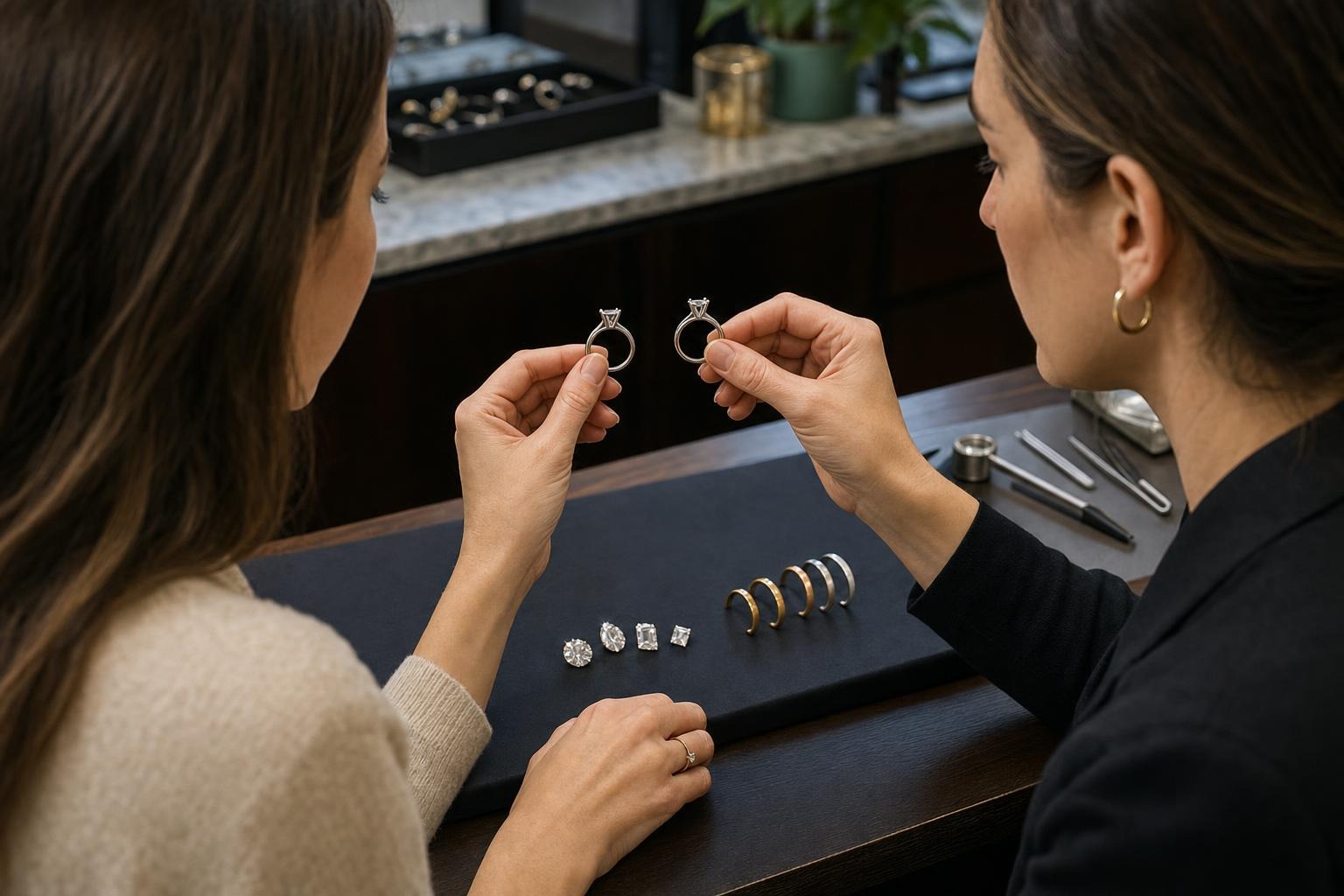
Buying an engagement ring in New York City is easiest when you make three decisions before comparing individual rings: set a total budget, identify the recipient’s priorities, and decide whether you want an in-stock piece or a custom design. With those choices in place, the Diamond District becomes a useful concentration of expertise and inventory rather than an overwhelming block of showcases.
DistrictGem offers certified, conflict-free diamonds, fine jewelry, and watches sourced in NYC’s Diamond District, including in-stock pieces and design-your-own options online. Whichever route you take, compare diamonds by their documented characteristics—not by showroom lighting or carat weight alone—and request clear information about the setting, sourcing, policies, and after-purchase service.
Key takeaways
- Establish one all-in budget covering the center stone, setting, tax, possible resizing, and insurance rather than shopping by diamond price alone.
- Prioritize the diamond characteristics a person can actually notice. Cut quality and overall appearance often matter more than reaching a particular carat number.
- Choose a setting for the wearer’s daily routine as well as visual style; high profiles and delicate pavé can require more care.
- Treat an independent grading report, an appraisal, and a seller’s sourcing statement as three different forms of information.
- Compare in-stock and custom routes early because they involve different levels of control, decision-making, and timing.
Build a complete engagement-ring budget
There is no universally correct amount to spend on an engagement ring, in NYC or elsewhere. Salary-based spending rules are marketing conventions, not financial standards. A sound budget is an amount you can pay without disrupting essential expenses, emergency savings, or other shared priorities.
Start with a maximum total rather than a target for the loose diamond. That total may need to cover:
- The center diamond or other approved components
- The setting and accent stones
- Sales tax
- Initial sizing or later resizing
- Shipping or secure pickup arrangements, if applicable
- An appraisal and insurance
- Future maintenance, especially for pavé or intricate designs
Once you have a ceiling, decide which variables are flexible. For example, someone who wants visible finger coverage may prefer a well-cut elongated shape over a higher color grade. Someone who loves a crisp, colorless appearance in white metal may place more of the budget toward color. A minimalist solitaire can leave more room for the center stone, while an intricate setting directs more of the total toward design and craftsmanship.
Ask sellers to present complete ring combinations within your limit. Comparing one loose diamond at a time can make it easy to overlook setting costs or drift beyond the original budget.
Compare diamonds using the 4Cs—and your eyes
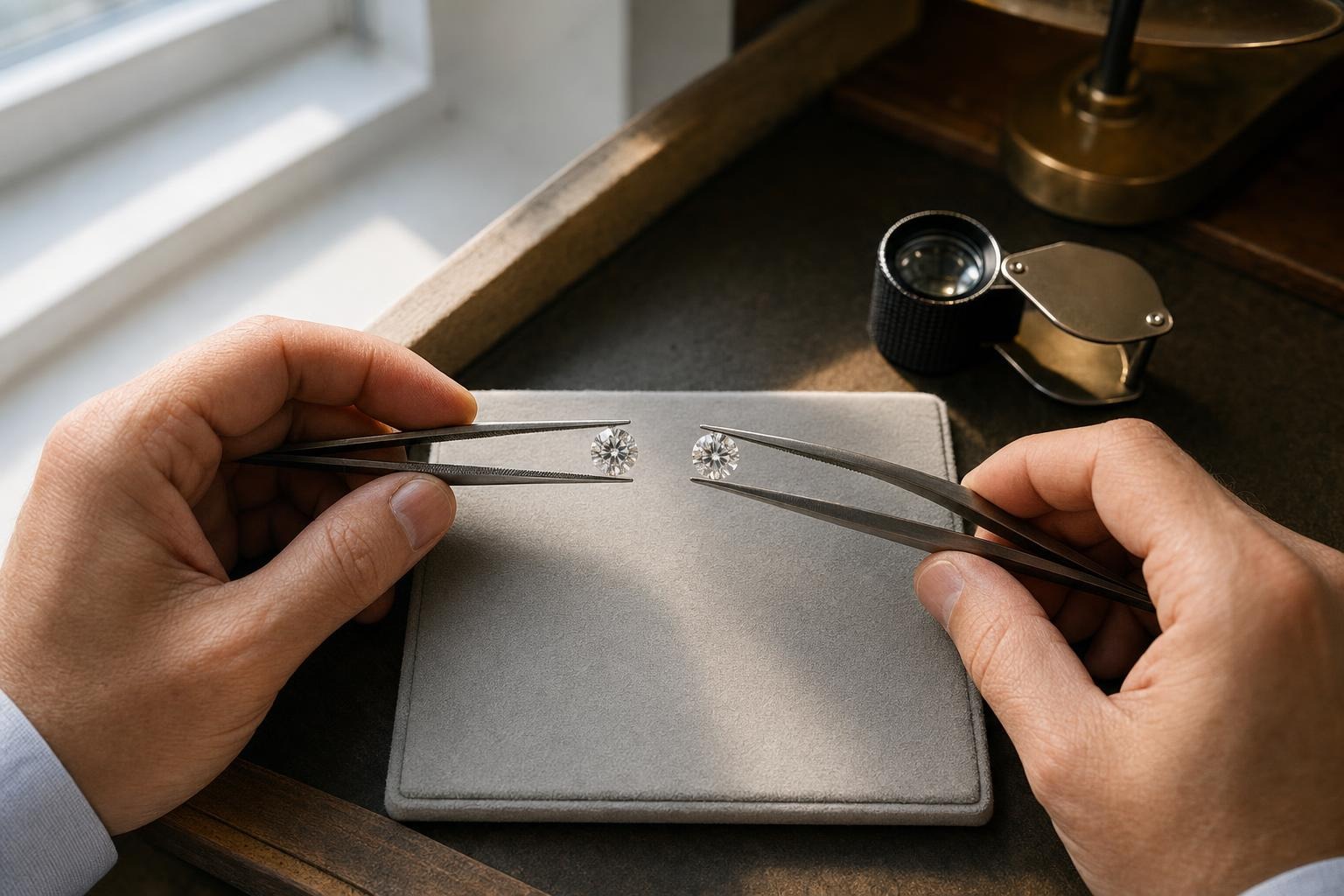
The 4Cs provide a common vocabulary for evaluating diamonds: cut, color, clarity, and carat weight. The Gemological Institute of America’s 4Cs overview explains how these characteristics are assessed. They are a starting point for comparison, not a formula that identifies one perfect stone.
Cut controls light performance
For round brilliant diamonds, cut grade describes how effectively the proportions and finish return light. A well-cut stone can appear lively across varied lighting, while a poorly proportioned stone may look dull despite strong color and clarity grades.
Fancy shapes—including oval, pear, emerald, cushion, and radiant cuts—require more visual judgment because their appearance can vary considerably. Compare outline, symmetry, light return, and the pattern of bright and dark areas. For elongated shapes, look for a balanced silhouette and ask whether a dark band across the center is noticeable under ordinary lighting.
Color should be judged in context
Diamond color grades describe the relative absence of color. Differences between neighboring grades can be subtle, particularly once a diamond is mounted. Metal color, stone shape, size, and personal sensitivity all affect what the wearer will perceive.
Compare candidates against the same background and in more than one lighting environment. A diamond that appears icy in concentrated display lights may look different near a window. Yellow or rose gold can also change the overall visual impression, allowing some shoppers to prioritize other characteristics.
Clarity is about visible features, not perfection
Clarity grades reflect internal inclusions and external blemishes under standardized examination. A higher grade does not automatically produce a visibly more beautiful ring. Ask whether any inclusions can be seen without magnification, whether they affect transparency, and where they sit within the stone.
Placement matters. A small feature near the edge may be less noticeable and could potentially be obscured by a prong, depending on the stone and setting. Never assume an inclusion is harmless or hideable without having the specific diamond examined.
Carat measures weight
Carat is a weight measurement, not a direct measurement of face-up size. Two diamonds of equal weight can have different dimensions because of shape and proportions. Review the measurements on the grading report and compare how each candidate looks from above.
Threshold shopping can carry a premium: a stone immediately below a round-number weight may look nearly identical once set. Judge the complete combination of dimensions, cut, and appearance rather than buying a number.
Select a setting and metal for real life
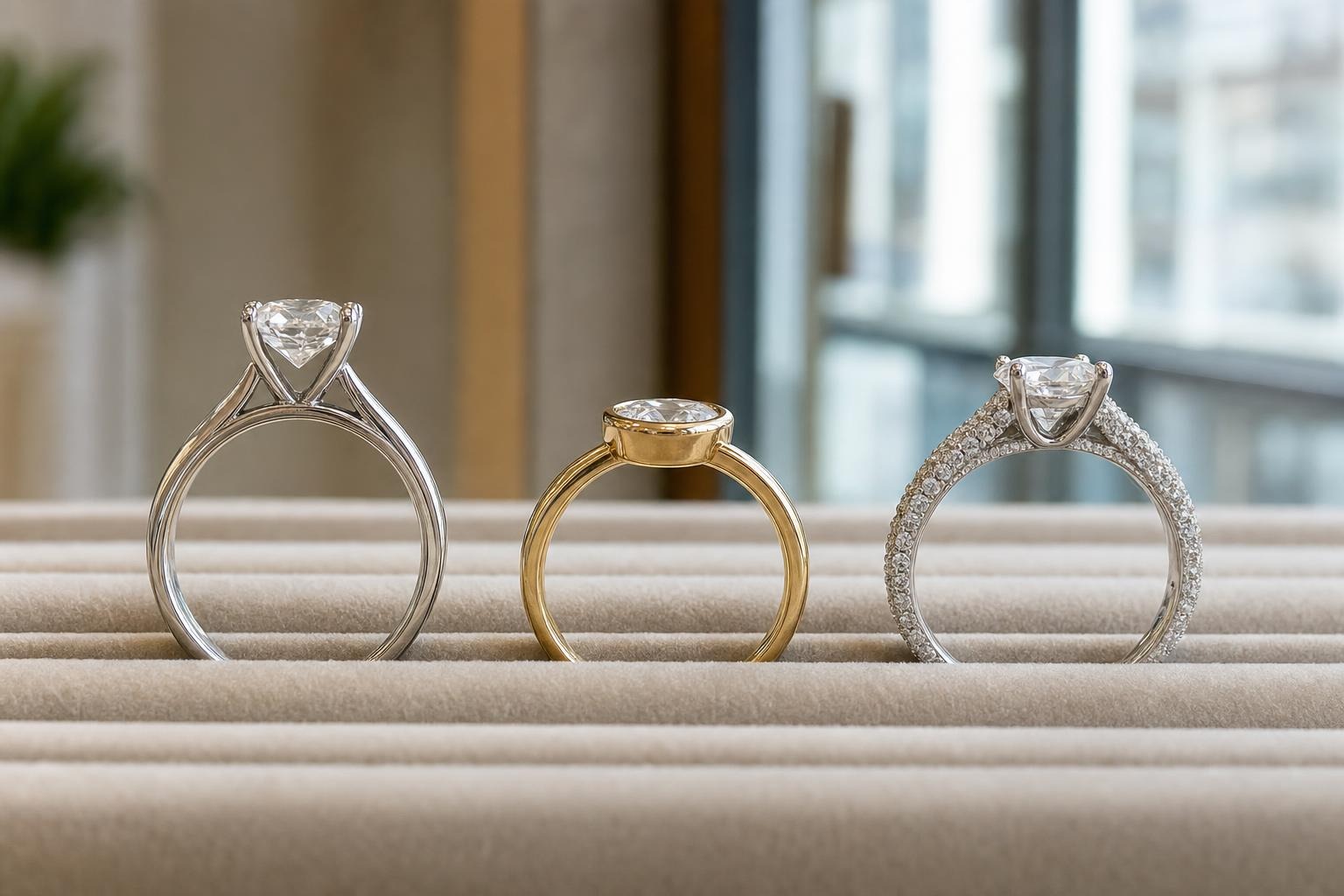
A setting gives the ring much of its character, but it also determines how high the stone sits, how easily the ring catches on clothing, and how much maintenance it may need.
A solitaire emphasizes the center stone and usually offers a straightforward visual profile. Halo settings surround the center with smaller stones, creating more sparkle and apparent coverage. Pavé places small diamonds along the band for brightness from multiple angles, while bezel settings surround more of the stone’s edge and can provide a streamlined appearance.
Consider the wearer’s work, hobbies, gloves, exercise habits, and tolerance for maintenance. A person who frequently works with their hands may prefer a lower profile or smoother edges. Fine pavé and delicate prongs should be inspected periodically, while wide or unusually shaped bands can affect comfort and future sizing.
Metal influences color, durability, upkeep, and price. Platinum is naturally white and dense. White gold offers a white-metal appearance but is commonly rhodium plated, so its finish may need renewal over time. Yellow and rose gold provide warmer contrast. Ask about the specific alloy and karat rather than relying on color alone, particularly if the wearer has known metal sensitivities.
If a wedding band will eventually sit beside the ring, evaluate that pairing now. Some engagement-ring profiles accommodate a flush band; others leave a gap or require a contoured companion band.
Decide between an in-stock ring and a custom design
An in-stock ring is the most direct route when you like the existing combination of stone, setting, metal, and size. You can assess the finished proportions immediately, and there are fewer design decisions to resolve. Confirm whether the pictured ring is the exact piece being sold or a representative example, especially when shopping online.
Custom design makes sense when the desired combination is difficult to find, when the wearer has strong preferences, or when proportions need to be tailored. It can also help integrate specific details such as an unusual center shape, lower profile, particular band width, or coordinated wedding band.
Customization does not automatically mean either cheaper or more expensive. Cost depends on the diamond, metal, structural complexity, accent stones, and labor involved. Likewise, there is no single reliable custom timeline. Before committing, ask for the process stages, decision deadlines, expected completion window, revision terms, and what happens if the finished ring needs adjustment.
Bring useful references, but explain what you like about each one. “A narrow yellow-gold band, low-set oval center, and no halo” gives a designer clearer direction than a folder of unrelated inspiration images. Ask how the design will protect the stone and whether requested proportions are practical for long-term wear.
Verify grading, sourcing, and seller policies
For a significant diamond purchase, request the grading report number and confirm that the report corresponds to the stone. Review the measurements, grades, plotted characteristics when provided, and any comments. A grading report describes gemological characteristics; it is not a guarantee of value, proof of ownership, or insurance appraisal.
An appraisal serves a different purpose, commonly documenting an item and an estimated replacement value for insurance. The appraised figure should not be treated as evidence that you received a bargain. Purchase price, grading information, and replacement valuation answer different questions.
“Conflict-free” also should not be confused with a clarity grade or laboratory report. Ask the seller what the term means in its supply chain, what supplier assurances or policies support the claim, and whether the explanation applies to the specific product. The international Kimberley Process addresses trade in rough diamonds, but shoppers can still request a seller’s own sourcing disclosures and supporting practices.
DistrictGem states that it offers certified, conflict-free diamonds sourced in NYC’s Diamond District. Buyers should still review the documentation associated with their chosen diamond and retain copies with the receipt.
Before paying, get the practical policies in clear language: return or exchange window, condition requirements, resizing terms, custom-order restrictions, warranty coverage, maintenance expectations, and responsibility during service or shipping. The Federal Trade Commission’s Jewelry Guides provide useful context on representations involving precious metals, gemstones, and jewelry products.
Shop the NYC Diamond District methodically
Manhattan’s Diamond District gives shoppers access to a concentrated jewelry market, but proximity does not make every offer directly comparable. Sellers may show diamonds with different grading documentation, proportions, policies, or levels of service. Plan the visit as a focused comparison rather than trying to inspect every window on West 47th Street.
Book appointments where appropriate and share your all-in budget, preferred shapes, approximate size range, metal, and timing. Limit the first comparison to a small group of relevant diamonds. Examine them side by side, first without knowing the prices if the seller permits, then review reports and costs.
Use ordinary viewing conditions. Look near a window or away from concentrated spotlights, and view each stone face-up from several angles. If the recipient is participating, test comfort, height, band width, and how the ring looks in motion—not just in a presentation box.
Bring these questions:
- Is this the exact diamond listed on the grading report?
- Can I verify the report number with the issuing laboratory?
- What is included in the quoted total?
- Is the setting appropriate for this stone’s dimensions?
- What are the return, resizing, and custom-order terms?
- What ongoing inspections or maintenance are recommended?
- How is the sourcing statement supported?
Avoid making a decision solely because an offer is described as available “today only.” A credible comparison remains grounded in the actual stone, finished design, documentation, and written terms.
Protect and maintain the ring after purchase
Check the fit soon after presentation, but remember that finger size changes with temperature and time of day. A ring that spins constantly or passes too easily over the knuckle may need adjustment. Some eternity bands, ornate designs, and rings with stones extending far around the shank can be difficult to resize, so discuss sizing limits before purchase.
Have the ring inspected at intervals appropriate to its construction and wear. Prongs can loosen, pavé stones can be vulnerable to impact, and finishes change over time. Remove the ring for activities that expose it to force, harsh chemicals, or loss, and clean it only with methods suitable for its stones and metal.
Consider insurance promptly. Ask an insurer whether jewelry is covered under an existing homeowners or renters policy, whether a separate endorsement is needed, and how loss, theft, damage, and replacement are handled. Store the receipt, grading report, appraisal, photographs, and identifying details securely. Keep digital copies separate from the ring itself.
Use this final buying checklist
Before placing an order, confirm that you can answer each of these questions:
- Is the complete price within the budget, including setting and tax?
- Does the diamond perform well outside jewelry-store spotlights?
- Have you reviewed its measurements and grading report?
- Does the setting suit the wearer’s style and routine?
- Will the intended wedding band fit as expected?
- Are the sourcing explanation and seller policies clear?
- Is the size confirmed, with resizing limits understood?
- Do the timing and customization stages fit your plans?
- Have you arranged secure storage, documentation, and insurance?
Frequently asked questions
Is it better to buy a loose diamond and setting separately?
Choosing them separately gives you more control over the diamond’s characteristics and the finished design. Buying a completed ring can be simpler because you immediately see the final proportions. In either case, confirm that the setting is structurally suitable for the exact stone.
Should I prioritize cut or carat weight?
If sparkle and liveliness are the priority, do not sacrifice cut quality merely to reach a larger round-number weight. For fancy shapes, compare visible light performance, dimensions, and outline because a single overall cut grade may not provide the complete answer.
How can I learn a partner’s ring size discreetly?
Borrow a ring worn on the correct finger only if you can do so safely, or ask a trusted person who genuinely knows. Finger sizes vary between hands, and estimates from photographs are unreliable. If uncertain, discuss how the chosen design can be resized before ordering.
Is a diamond grading report the same as certification?
People often use “certified” conversationally, but laboratories generally issue grading reports describing the stone at the time of examination. Read the issuing laboratory’s terms and verify the report number. The report is separate from a sales warranty, appraisal, or sourcing statement.
Can every engagement ring be resized?
No. Resizing feasibility depends on the metal, band construction, size change, engraving, and placement of accent stones. Full eternity bands and highly intricate settings can be especially restrictive. Confirm the practical sizing range before purchase.